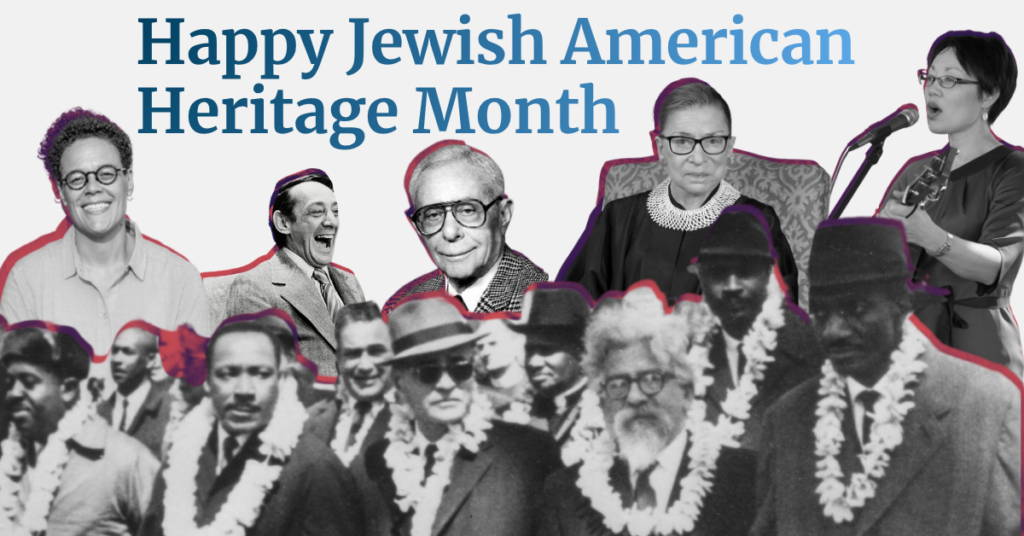
Section 1: Education Partners
Jewish Contributions to Education and Academic Life
Jewish Americans have played a central role in shaping American education—expanding access, defending academic freedom, and advancing inclusive curricula.
- Jewish educators and advocates were deeply involved in building the American public school system and expanding access to higher education
- Jewish scholars have contributed across disciplines, from science and medicine to literature, law, and social theory
- Jewish organizations and leaders have been at the forefront of efforts to ensure that education remains a space for critical inquiry, pluralism, and democratic engagement
Jewish experience—rooted in a long tradition of learning, debate, and textual analysis—has also helped shape core educational values like intellectual curiosity, rigorous inquiry, and respect for diverse perspectives.
How Education Partners Can Engage
- Incorporate Jewish American history and contributions into curricula and programming
- Use resources like the Weitzman National Museum of American Jewish History Share My Lesson materials, the result of a partnership between the Weitzman Museum, the American Federation of Teachers, and JCPA.
- Defend academic freedom while ensuring that Jewish students feel safe and included on campus and in the classroom
- Create space for Jewish voices and perspectives in broader DEI and inclusion efforts
History of Jews and Education in America
- Jewish involvement in American education has been deeply rooted in both cultural tradition and democratic aspiration, spanning from the 19th century to the present.
- Jewish culture has long emphasized literacy, study, and debate, with education functioning as both a religious and communal cornerstone. As Jewish immigrants arrived in the United States in large numbers between 1880 and 1924, they brought with them a strong commitment to learning as a pathway to opportunity and integration.
- Jewish immigrants and their descendants played a key role in expanding access to public education and higher education. At a time when many elite institutions imposed quotas or excluded Jews entirely, Jewish communities helped build alternative pathways, including expanding public universities, community colleges, and scholarship systems.
- Jewish Americans were also central to movements defending academic freedom and pluralism. During the McCarthy era, Jewish academics were among those targeted for their political views, and Jewish educators and activists helped galvanize broader protections for free expression in education.
- In the postwar period, Jewish leaders and organizations were deeply involved in civil rights struggles that reshaped American education, including desegregation efforts following Brown v. Board of Education. Jewish activists, lawyers, and educators worked alongside Black leaders to advance equal access to education and combat discrimination.
Key Jewish Figures in Education
- Henry Rosovsky – Helped reshape undergraduate education at Harvard, expanding access and modernizing curriculum structures.
- Jerome Bruner – A leading figure in cognitive psychology and educational theory who helped shape modern approaches to learning and curriculum design.
- Maxine Greene – Advanced progressive education, emphasizing imagination, social justice, and inclusive pedagogy.
- Randi Weingarten – A longtime educator and current President of the American Federation of Teachers.
Section 2: Labor Partners
Jewish Contributions to the Labor Movement
Jewish Americans have been foundational to the American labor movement, helping to organize workers, build unions, and secure critical protections that benefit all working people.
- Jewish immigrants were central to early 20th-century labor organizing, particularly in garment and industrial sectors
- Jewish labor leaders helped lead major strikes and campaigns that advanced fair wages, safe working conditions, and collective bargaining rights
- Jewish values such as tzedek (justice) and tikkun olam (repairing the world) have long informed a commitment to worker justice and solidarity
From the Triangle Shirtwaist Factory fire to the rise of major unions, Jewish workers and organizers have helped shape the labor protections many rely on today.
How Labor Partners Can Engage
- Highlight the role of Jewish workers and organizers in labor history
- Partner with Jewish organizations and affinity groups / caucuses within unions
- Ensure that efforts to advance worker justice are inclusive of Jewish workers and responsive to antisemitism
- Reinforce that solidarity across communities is essential to building worker power
History of Jews and the Labor Movement
- Jewish involvement in the American labor movement has been foundational, stretching from the 19th century through the New Deal and into the modern civil-rights era.
- Between 1880 and 1924, roughly 2.5 million Jewish immigrants arrived in the United States, fleeing pogroms and antisemitism in Eastern Europe. Many worked in dangerous, low-wage industries such as garments, textiles, and manufacturing.
- By the early 20th century, Jews made up majorities or large pluralities in key garment trades, especially in New York City, Chicago, and Philadelphia. In some New York garment sectors, Jews comprised 40–60% of the workforce.
- The 1909 “Uprising of the 20,000” led largely by young Jewish immigrant women garment workers, established mass strike organizing and women’s leadership within the labor movement.
- The Triangle Shirtwaist Factory Fire (1911), which killed 146 workers, many of them Jewish and Italian women, galvanized labor-backed reforms on workplace safety, fire codes, and labor regulation.
- Jewish labor leaders and unions were central allies in New Deal reforms, including the Fair Labor Standards Act, minimum wage laws, overtime protections, and collective bargaining rights. When Rose Schneiderman, a central leader in the Uprising of the 20,000, died in the early 1970s, the NYT obituary claimed that Franklin and Eleanor Roosevelt learned “everything they knew about unions” from her.
Key Jewish Labor Figures
- Samuel Gompers, the son of Jewish immigrants, founded and led the American Federation of Labor (AFL) for nearly four decades and helped shape modern American trade unionism.
- Sidney Hillman, a Lithuanian Jewish immigrant, led the Amalgamated Clothing Workers of America and became one of the most influential labor leaders of the New Deal era, advising President Franklin Roosevelt. He was a founder of the Congress of Industrial Organizations (CIO), and became Vice-President of the CIO when it established itself as a separate union confederation in 1937.
- Rose Schneiderman, a Polish Jewish immigrant and garment worker, emerged as a leading feminist and labor organizer a fter the Triangle Shirtwaist Factory fire.
- David Dubinsky, a Jewish immigrant from Belarus, led the International Ladies’ Garment Workers’ Union (ILGWU) for decades and expanded unions’ role in healthcare, housing, education, and anti-fascist organizing.
- Abraham Cahan was the longtime editor of The Forward, the influential Yiddish-language newspaper that educated and mobilized hundreds of thousands of Jewish immigrant workers.
- Clara Lemlich – leader of the Uprising of 20,000, the largest woman’s strike to date in American history, organized by largely Yiddish speaking immigrants.
Section 3: Civil Rights Partners
Jewish Contributions to Civil Rights
The Torah teaches that when humans were created, they were made b’tzelom elohim – in the image of God. Guided by this belief in the divinity in all of us, the Jewish community has long worked to advance civil rights for all Americans, working extensively on desegregation, voting rights, and ending discrimination in housing, education, and employment, expanding over the years to encompass not just racial and religious discrimination, but also that based on gender, gender identity, and sexual orientation.
- Jewish leaders at the Jewish Council for Public Affairs, recognizing that Jewish civil rights could only be won and protected through coalition, joined with the NAACP in 1950 to found the Leadership Conference on Civil and Human Rights to serve as a clearinghouse and coordinating body for all civil rights advocacy.
- Under this leadership, key legislation, like the Civil Rights Act of 1964 and the Voting Rights Act of 1965, were drafted in the conference room of a Jewish organization – the Religious Action Center of Reform Judaism
- Jewish advocates risked – and even lost – their lives as Freedom Riders, working to support Black people in the Jim Crow South register to vote.
JCPA and our partners remain as steadfast today in our commitment to fighting the discrimination and systemic racism that persist across all facets of our society . We seek to protect and expand the civil rights of all, for a nation free from discrimination on the basis of race, religion, gender, sexual orientation, and disability.
How Civil Rights Partners Can Engage
- Highlight the universality of civil rights. We are not safe unless we are all protected.
- Partner with Jewish organizations working on voting rights or promoting broader civil rights and diversity measures
- Ensure that civil rights spaces are inclusive of Jewish perspectives and responsive to antisemitism – understanding that when Jews are not welcome, our coalitions and our democracy are threatened
- Emphasize shared values of dignity, safety, and opportunity for all
Key Jewish Figures in Civil Rights
- Rabbi Abraham Joshua Heschel – A leading scholar of modern Jewish thought, Rabbi Heschel fled the Nazis and was brought to teach in America where he became a leader in the civil rights movement and a partner of Martin Luther King Jr. In 1965, Heschel marched arm in arm with Dr. King from Selma to Montgomery, saying “I felt my legs were praying.”
- Arnold Aronson – A former JCPA leader – known at the time as the National Community Relations Advisory Council – Aronson was a founder of the Leadership Conference on Civil Rights in 1950. He said, “The struggle for civil rights cannot be won by any one group acting on its own; it can only be achieved through a coalition of groups that share a common commitment to equal justice and equal opportunity for every American.”
- Michael Schwerner and Andrew Goodman – Michael and Andrew went to help register Black voters in the South as part of Freedom Summer. They were murdered – along with fellow activist James Chaney, a Black man – in Mississippi
- Rose Schneiderman – An immigrant from Poland, Schneiderman was a founding member of the American Civil Liberties Union. After the tragic Triangle Shirtwaist Factory fire, Schneiderman became involved in labor and union organizing and eventually a leading suffragist, knowing that the only way to secure protection through the laws was for women to have the right to vote.
Section 4: Immigration Justice Partners
Jewish Contributions to Immigration Justice
The Jewish American story is, in many ways, an immigrant story. Generations of Jews came to the United States seeking safety, opportunity, and freedom—and have since played a leading role in advocating for humane and just immigration policies.
- Jewish immigrants helped build American communities, institutions, and industries
- Jewish organizations, including groups like HIAS, have long supported refugees and asylum seekers of all backgrounds
- Jewish advocacy has been central to efforts to protect vulnerable populations, expand refugee resettlement, and uphold the dignity of immigrants
Jewish tradition includes a deep emphasis on welcoming the stranger—grounded in the historical experience of displacement and the moral imperative to ensure others are treated with dignity.
How Immigration Justice Partners Can Engage
- Highlight the parallels between Jewish immigrant history and contemporary immigrant struggles
- Partner with Jewish organizations working on refugee and immigrant rights
- Ensure that immigrant justice spaces are inclusive of Jewish perspectives and responsive to antisemitism
- Emphasize shared values of dignity, safety, and opportunity for all
History of Jews and Immigration Justice
- The Jewish American experience is fundamentally shaped by migration, displacement, and the pursuit of safety and opportunity, making Jewish communities central to the history of immigration in the United States.
- Between 1880 and 1924, approximately 2.5 million Jews fled persecution, pogroms, and economic hardship in Eastern Europe and arrived in the United States. Like many immigrant groups, they faced xenophobia, economic exploitation, and restrictive immigration policies.
- The passage of the Immigration Act of 1924 severely curtailed Jewish immigration, leaving many Jews trapped in Europe during the rise of Nazism. The failure of the United States and other countries to admit Jewish refugees during the Holocaust remains a defining moment in Jewish communal memory and a driving force behind modern refugee advocacy.
- In response, Jewish communities built institutions to support immigrants and refugees, most notably HIAS, originally founded in 1881 to assist Jewish immigrants and now a global refugee resettlement organization serving people of all backgrounds.
- Jewish advocacy was instrumental in shaping modern refugee and immigration policy, including support for the Refugee Act of 1980, which established the U.S. refugee resettlement system. Jewish organizations and leaders have consistently pushed for more humane immigration policies, protections for asylum seekers, and pathways to citizenship.
- Jewish tradition reinforces this commitment. The commandment to “welcome the stranger” appears dozens of times in the Torah, often explicitly linking ethical responsibility to the Jewish historical experience of being strangers in Egypt.
- Today, Jewish organizations remain deeply engaged in immigration justice work, partnering across communities to advocate for refugees, oppose family separation, and promote policies rooted in dignity and human rights. We have also seen extremists exploit the Jewish commitment to immigrant justice to advance violent hate – such as the white supremacist attacks in Charlottesville, Pittsburgh (the deadliest attack on the Jewish community in U.S. history), Poway, El Paso, and Buffalo, all of which were rooted in antisemitic, xenophobic, and racist “replacement” conspiracy theories.
Key Jewish Figures in Immigration Justice
- Emma Lazarus – Author of “The New Colossus,” the poem inscribed on the Statue of Liberty, which helped define the United States as a refuge for immigrants: “Give me your tired, your poor…”
- Lillian Wald – Founder of the Henry Street Settlement, Wald worked extensively with immigrant communities and advocated for social services, labor protections, and immigrant rights.
- Jacob Schiff – A major funder of efforts to support Jewish immigrants and advocate against restrictive immigration policies in the early 20th century.
Section 5: Sample Social Media Posts
Jewish American Heritage Month is this May — a time to celebrate the generations of Jewish Americans who have helped shape our nation. Show your support for Jewish communities and stand up for Jewish safety by amplifying their stories and legacy on your social media platforms.
Celebrating the Legacy of Jewish Americans:
X/Bluesky:
Jewish Americans have shaped this country for 350+ years — helping build the labor movement, marching for civil rights, welcoming refugees, and writing the words on the Statue of Liberty. This May, we celebrate their lasting legacy. #JewishAmericanHeritageMonth #JAHM
X/Bluesky:
Jewish safety and our inclusive democracy are inextricably linked — and 350+ years of Jewish American history proves it. This May, we celebrate the generations of Jewish Americans who helped build this democracy and whose safety is essential to its future. #JewishAmericanHeritageMonth #JAHM
X/Bluesky:
There is no inclusive, pluralistic democracy without true Jewish safety – just as protecting our democracy is inherent to Jewish safety. This #JewishAmericanHeritageMonth we recommit to the fight against antisemitism wherever it exists and to building an America in which all of us are safe. #JAHM
Instagram/Facebook/LinkedIn: Jewish Americans have helped shape this country for more than 350 years.
They helped build the labor movement. They marched for civil rights. They welcomed refugees. They defended academic freedom. They wrote the words on the Statue of Liberty.
This May, we celebrate Jewish American Heritage Month — and the generations of Jewish Americans whose contributions have made this country stronger, fairer, and freer. Honoring that history means protecting the pluralistic democracy in which Jews — and all people — are safe and free, because Jewish safety and inclusive democracy are inextricably linked.
#JewishAmericanHeritageMonth #JAHM
Jewish Americans Have Led on Protecting and Expanding American Democracy:
X/Bluesky:
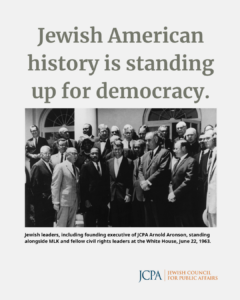
Jewish Americans have been at the forefront of the fight for civil rights and democracy — building coalitions, drafting landmark legislation, and standing up for the rights of all Americans. This May, we honor that legacy. #JewishAmericanHeritageMonth #JAHM
X/Bluesky:
The Jewish American community has long helped lead the fight for the inclusive democracy that protects all of us.
This #JewishAmericanHeritageMonth, we continue to fight in coalition together to strengthen the pluralistic, multiracial democracy that keeps us all safe. #JAHM
Instagram/Facebook/LinkedIn: This Jewish American Heritage Month, we’re honoring the leaders who built the coalitions that made civil rights history possible.
Arnold Aronson, who led the Jewish Council for Public Affairs, co-founded the Leadership Conference on Civil Rights in 1950 alongside the NAACP — helping lay the groundwork for the Civil Rights Act and Voting Rights Act, both landmark pieces of legislation that protected all Americans literally drafted in the conference rooms of Jewish organizations.
Jewish Americans have long understood that none of us are free until all of us are free — and that Jewish safety is most assured in a just, inclusive democracy where the rights and safety of all communities are protected. This May, we celebrate that legacy and recommit to the coalition-building across lines of difference that makes progress possible for everyone.
#JewishAmericanHeritageMonth #JAHM
Jewish Americans have Always Known the Immigrants Makes America Stronger:
X/Bluesky:
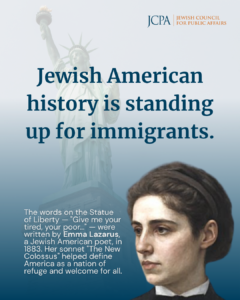
From Emma Lazarus’s words on the Statue of Liberty to generations of advocacy, Jewish Americans have long championed the rights of immigrants and refugees — knowing firsthand what it means to seek safety in a new home. #JewishAmericanHeritageMonth #JAHM
X/Bluesky:
Jewish Americans have always known: the Jewish community is only safe when all people are safe. From Emma Lazarus to today, that commitment to an inclusive democracy has defined our community’s legacy. #JewishAmericanHeritageMonth #JAHM
Instagram/Facebook/LinkedIn: This Jewish American Heritage Month, we’re celebrating the generations of Jewish Americans who have stood up for immigrants and refugees — knowing firsthand what it means to seek safety in a new home.
Few examples capture this more powerfully than Emma Lazarus, the Jewish American poet whose words — “Give me your tired, your poor, your huddled masses yearning to breathe free” — were inscribed on the Statue of Liberty in 1903, defining America’s promise to all who seek refuge here.
Jewish tradition commands us to welcome the stranger. For Jewish Americans, that has never just been a value — it has been a lived commitment, rooted in the understanding that Jewish safety and inclusive democracy are inextricably linked. Policies that promote exclusion and embolden extremism put us all at risk. Protecting the rights and dignity of all communities is how we protect each other.
#JewishAmericanHeritageMonth #JAHM
Section 6: Additional Resources
Mainstream Jewish Groups Reject the False Choice Between Jewish Safety and Democracy: In April 2025, JCPA brought together a broad coalition of ten mainstream Jewish organizations — spanning three of the four major denominations — to issue a joint statement rejecting the false choice between fighting antisemitism and upholding democracy, affirming that Jewish safety has always depended on the rule of law and the protection of rights for all.
Antisemitism x Democracy Report: JCPA’s Antisemitism x Democracy framework reminds us that fighting antisemitism and protecting democracy are inseparable. Because antisemitism fuels conspiracy theories and extremism that threaten all communities, and because Jewish safety is only possible in a pluralistic democracy where everyone’s rights are protected, we encourage partners to utilize the framing in order to substantiate the need for why Jewish safety and celebrating Jewish Americans’ contributions is a critical need this Jewish American Heritage Month.